You’re a healthcare executive, and instead of focusing on strategy, quality, and patient outcomes, you’re spending an inordinate amount of time running interference.
Two or more of your senior leaders or clinicians are in ongoing conflict. Meetings are tense (or repeatedly canceled). Decisions stall. Communication happens sideways instead of directly.
You’re pulled into conversations that should not require your involvement at this level, yet if you step back, things deteriorate further.
You can see the downstream impact clearly: loss of productivity, fractured leadership alignment, and growing patient safety risks.
The problem is, you don't want to dismantle your team, and the people involved aren’t easy to replace. They are physicians, APPs, or senior leaders with institutional knowledge, professional credibility, and clinical expertise. You don’t have the luxury of waiting this out or hoping it resolves on its own.
So you’re stuck holding a situation that shouldn’t be yours to carry, knowing it has to be resolved, and knowing that what you’ve tried so far hasn’t worked.
Jump to Program Options
What You've Tried
You’ve tried serving as the mediator yourself, attempting to get the people involved to talk to each other directly. You’ve tried triangulating—carrying messages back and forth—to reduce friction and keep things moving.
You’ve involved your internal HR or Employee Resources staff to facilitate conversations, only to find they’re either not qualified for this level of complexity or not effective in practice.
Despite your efforts, the conflict persists.
Why It's Hard
Like many executives, you expect adults to get along and resolve differences professionally. When that doesn’t happen, it’s both surprising and deeply frustrating.
As the executive, this is where you need to hold firm boundaries with real consequences, so everyone understands that the conflict cannot continue. You were never trained to be a professional conflict resolution facilitator (and you shouldn’t have to be).
At the same time, HR professionals are often either not competent in complex, high-stakes interpersonal conflict or not trusted by clinicians and leaders who fear political or professional repercussions.
This leaves you in an impossible position: responsible for outcomes you can’t directly control, in a system that doesn’t reliably support real dialogue or psychological safety.
The problem is that the tools typically available to you aren’t designed for the realities of senior-level healthcare conflict.
The Truth & The Approach That Works
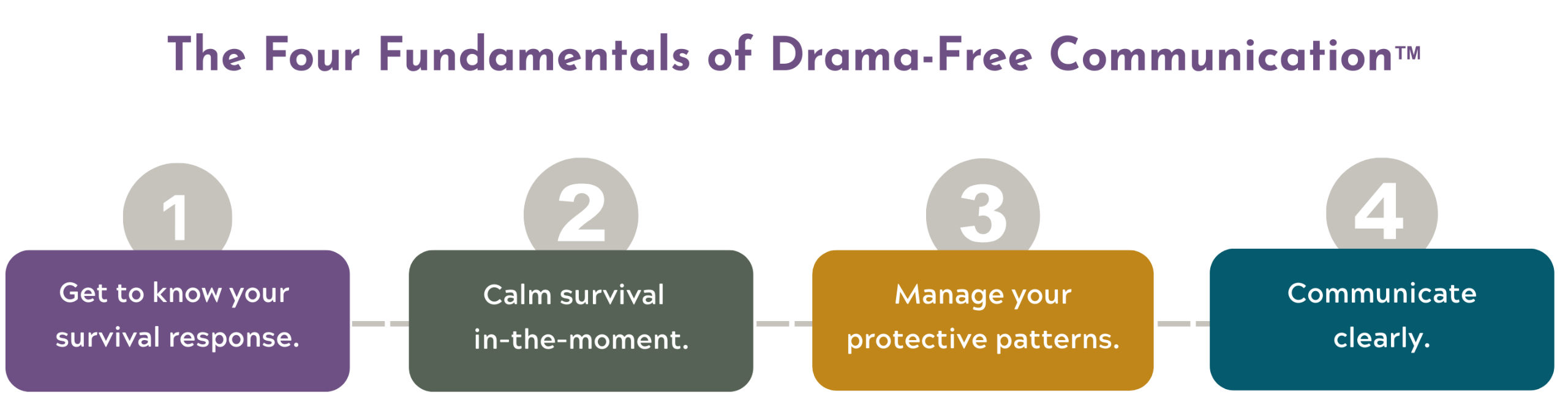
Typical mediation trainings and facilitations fail because they leave out or gloss over this one crucial element: Nervous system regulation to get out of survival mode (fight / flight / freeze / please).
You want your people to stop the drama, but first you need to create the conditions where people can speak honestly, feel heard and be understood.
Because no one, no matter how well-educated and experienced they are, can communicate clearly until they have shifted out of survival mode and managed their survival-driven protective patterns (aggression, people-pleasing, micro-managing, etc.).
That's why all of my programs are built on my Four Fundamentals of Drama-Free Communication.
What actually works is having someone who can quickly
- assess and ascertain the root drivers of the conflict,
- create psychological safety and trust with the leaders involved, and
- facilitate true dialogue so the conflict can be fully resolved.
In my experience, people in conflict need to feel respected as they are. They need a sense of hope that they can be who they are and still succeed, that it’s okay to have emotions, strong opinions and challenges, and that they don’t have to change their personality to work effectively with others or succeed within their organization.
The reason I’m able to support this kind of resolution is that I help people recognize when they are moving into survival mode (fight / flight / freeze / please). From there, we slow things down enough to identify the core concern driving the conflict, and build a foundation of trust between the people involved so they can finally resolve their conflict, repair their professional relationships, and move forward.
When that happens, resolution becomes sustainable, without you having to remain in the middle.
Meet Your Coach
Hi, I’m Annie Campanile, a PhD executive coach with 20+ years of experience in healthcare executive coaching and conflict resolution facilitation.
I’ve been an executive coach in five large health systems across the U.S., and I’ve facilitated complex conflict resolution with leaders at every level—from nursing directors and APPs, to vice presidents, physicians, and chief officers.
Many people find persistent conflict among senior leaders to be intimidating, but I don't.
I understand the organizational pressures, the clinical culture, and the high stakes involved in healthcare.
I view senior leaders and clinicians as people, with the same sensitivities and need for caring as those under their care. Very often, they are expected (or expect themselves) not to have those sensitivities or needs, and also to be good at everything simply because they are experts in their field.
In reality, most have never been formally trained to navigate high-stakes communication under pressure. They were trained to diagnose, to deliver care, to manage operations, to drive organizational outcomes—not to stabilize tense conversations between accomplished, opinionated professionals whose reputations and authority are on the line.
That's where I come in.
My specialty is helping healthcare leaders and clinicians hold difficult conversations safely and directly, so they can
-
resolve tension early so it stops escalating into formal complaints or attrition
-
maintain authority without intimidation
-
communicate confidently without triggering defensiveness or avoidance
-
strengthen collaboration, trust, and performance under pressure
Conflict does not have to end in resignation, retaliation, or disengagement. With the right structure and facilitation, it can become a turning point.
Learn more about me

Program Options and 2026 Pricing
There are four ways to work with me on Conflict Resolution, depending on what you need right now.
Click a title to quickly view details.

Conflict Triage and Strategy Consult
I advise you, the executive, on how to approach the situation and prepare for your next steps.
Duration: 90 minutes
Format: Video conference
Investment: $1,750
Best when
-
You are facing a conflict and need rapid clarity about:
-
what’s really going on
-
what options are viable
-
what to do next
-
-
You want an external expert lens on strategy before deciding whether to:
-
handle internally
-
get trained to facilitate
-
partner with an external facilitator
Next Step
For more information
Request a Clarity Call
High-Stakes Communication Coaching
I coach a leader or clinician whose communication under pressure is putting their credibility, their role, team relationships, and/or patient experience at risk.
This focused intervention stabilizes stress-driven communication patterns before they escalate into job loss or lasting reputational damage. It goes beyond communication scripts or personality insights, addressing the underlying Protective Patterns that drive reactive escalation or conflict avoidance when the stakes are high.
This program is appropriate when the primary issue is individual high-stakes communication risk, not a multi-party conflict.
Duration: 6 months
Format: Video conference
Investment: Starting at $18,000
This program may be sponsored by an organization or purchased directly by the leader/clinician, for independent support.
Best when
The organization wants to retain a technically strong leader or clinician, but needs to see rapid, observable improvement in communication patterns that are generating risk.
Also best when
-
complaints about the individual's tone, reactivity, or interpersonal conduct are increasing or stakeholders have lost confidence due to conflict avoidance or rigidity
-
HR or executive leadership has intervened (or is preparing to intervene)
-
the individual is highly competent but ineffective under stress, because they avoid difficult conversations or do not hold them well
-
the individual wants the support of confidential, structured coaching and is ready to engage fully in the process
Core Components
-
Pre/Post assessment filled out by individual and their leader (if the coaching is sponsored by the organization)
-
Opening goal setting and alignment session to define 1–2 priority behaviors and 1–2 key relationships to stabilize
-
Individualized assessment of stress-response triggers, conflict avoidance patterns, and defensive communication habits
-
Instruction in the Four Fundamentals of Drama-Free Communication applied to live cases
-
Nervous-system stabilization strategies to prevent reactive outbursts and reduce avoidance/people-pleasing
-
Structured preparation and rehearsal for high-stakes conversations (including clarity, empathy, and timing)
-
Relationship repair planning, where performance has been weakened by reactivity or avoidance
-
Between-session support and real-world application
-
Closing review and sustainment strategy
Stakeholder input, periodic sponsor alignment sessions, and DiSC or Hogan Assessment may be included when appropriate, to clarify expectations and behavioral goals, and to inform self-awareness.
Key Roles
-
Sponsor (executive leader or HR): clarifies expectations and behavioral standards, provides accountability where needed, and participates in periodic sponsor alignment check-ins (facilitated by Dr. Annie) focused on agreed-upon coaching goals.
-
Dr. Annie: I assess communication patterns and risk, design the stabilization strategy, coach for clear communication, guide planning for difficult conversations, facilitate debriefs to integrate learning afterward, and help the leader/clinician build capacity to stay steady under pressure.
-
Leader/Clinician (participant): attends coaching sessions consistently, completes self-assessments, practices tools between sessions, and uses coaching to prepare for, carry out, and debrief high-stakes conversations.
Measures of Success
During our Opening Goal Alignment Session, we will clarify your unique measures of success. Common examples include:
What others can observe:
-
Fewer complaints or escalations related to the leader’s/clinician’s communication
-
Clear improvement in one or two high-impact behaviors (e.g., tone under pressure, timely follow-through, responsiveness)
-
More productive high-stakes conversations (less avoidance or reactivity; clearer decisions and next steps)
What the leader/clinician can reliably experience:
-
Faster recovery after tense interactions (less rumination, regret, fatigue)
-
Increased ability to notice stress responses early and use a reset to stay grounded and communicate effectively
-
Greater confidence initiating the difficult conversations they’ve been avoiding, and holding them well
Ethical Boundaries
I am not the decision-maker on disciplinary action, organizational policies, clinician credentialing, or HR outcomes. This coaching is not an HR investigation, legal mediation, or therapy.
Confidentiality is protected. If the engagement is sponsor-funded, sponsor updates focus on agreed-upon behavioral goals and observable progress markers and do not include session content, personal history, or private details shared in coaching.
This program is not appropriate if:
-
the organization’s goal is punitive rather than corrective and stabilizing
-
no sponsor is willing to clarify expectations and support accountability (when sponsor-funded)
-
active investigation and/or legal processes make coaching inappropriate (a strategy consult may be a better first step)
-
the organization expects to receive reports that violate confidentiality or disclose session content
Next Step
For more information
Request a Clarity Call
Skill Building for One Internal Facilitator
I teach you (executive leader, HR business partner, or Employee Relations advisor) how to facilitate resolution yourself and I coach you through a real case.
This active learning program goes beyond typical mediation training and executive coaching programs, so you can confidently handle your current situation (and future ones) without being dependent on outside intervention.
Duration: up to 3 months
Format: Video conference
Investment: $25,000
Best when
-
The organization wants to keep facilitation internal (for access, speed, cost, or culture reasons) and needs:
-
a rigorous process design
-
neutral structure
-
skill support to prevent the conversation from going sideways
-
-
The conflict is of low to moderate complexity, the internal facilitator has credibility with all parties, and the organization can provide supplemental resources to support the facilitator
Core Components
-
Individualized instruction on my Four Fundamentals of Drama-Free Communication and my proven approach to facilitating conflict resolution
-
Individual coaching sessions + support between sessions to help you prepare for, debrief, and learn from an actual facilitation process
-
DiSC assessment + individual debriefs for you and the (2-3) people who are in conflict
-
Opening alignment session
-
Closing review and sustainment session
Key Roles
-
Sponsor: ensures authority, resources, and consequences where needed, to support resolution of the conflict
-
Dr. Annie: I design the facilitation approach, train and coach the facilitator (you), provide tools, help plan the conflict facilitation sequence, coach you on de-escalation and relationship repair, debrief the facilitated meetings to deepen learning and build competence
-
Internal facilitator: participates fully in this program, runs the facilitated meetings, documents as needed per organizational policy, ensures participants generate clear, behavioral agreements that strengthen their professional relationship
Next Step
For more information
Request a Clarity Call
Direct Facilitation to Resolve Conflict
I facilitate the conflict resolution process for you, working directly with the hard-to-replace clinicians and/or leaders involved in the conflict.
Duration: 6-8 weeks
Format: Video conference + In person (optional)
Investment: $35,000
Best when
-
The conflict is urgent, too complex, or too politically charged for internal facilitation
-
Facilitator's neutrality is essential and/or too challenging for internal facilitators
-
Parties are entrenched in conflict and prior attempts at resolution have failed
-
Expectations of resolution and consequences of continued conflict have been made clear to the parties
-
Parties are committed to resolving their conflict and want the support of a skilled facilitator
Core Components
-
Orientation to my Four Fundamentals of Drama-Free Communication and my proven approach to facilitating conflict resolution
-
Opening alignment and goal-setting session with you, up to 2 other executives whose direct reports are involved in the conflict, and up to 2 organizational resources you want to include (such as HR / Employee Relations / Medical staff relations)
-
DiSC assessment + individual debriefs the (2-3) people who are in conflict and their direct leaders
-
Individual "pre-brief" coaching sessions for each of the (2-3) people who are in conflict, to prepare for the facilitated conversation
-
One facilitated conflict resolution meeting (additional meetings available, at an additional fee)
-
Closing review and sustainment session
-
Additional deliverables as appropriate to your unique situation and scope
Key Roles
-
Leader(s) of the parties who are in conflict (you): Your role is to set clear expectations and real consequences for the people who are in conflict, attend the facilitated conversation as a resource, sponsor any new agreements or action plans that emerge from the facilitation, and periodically review progress with the parties. You retain authority for employment actions and policy enforcement.
-
Dr. Annie: I am the neutral facilitator and process owner (within agreed scope). I lead the pre-briefs, structure the facilitated conversation, manage escalation in real time, facilitate clear agreements between the parties, and design follow-through.
Measures of Success
-
During our clarity call, we will clarify your unique measures of success. Common examples include the following:
-
Clear, behavior-based agreements and compliance with them
-
Reduction in complaints about and/or escalations between the parties
-
Improved working relationship (not necessarily “friendship”) between the parties
-
Reduced operational drain (meetings avoided, workarounds, colleague complaints, attrition)
Ethical Boundaries
-
I am not the decision-maker on disciplinary action, organizational policies, clinician credentialing, or HR outcomes.
-
This program is not appropriate if:
-
no sponsor is committed to supporting and enforcing follow-through after the facilitated conversation
-
the organization is using “facilitated conflict resolution” to achieve punitive goals
-
the organization expects to receive reports that would violate confidentiality of the parties
-
there are unresolved investigation and/or legal processes that make facilitation inappropriate (A strategy consult—Option 1 above—might be appropriate in those situations).
Next Step
For more information
Request a Clarity CallRequest A Clarity Call
If you would like help choosing the right program or you are ready to get started, book a free 30-minute Clarity Call.
This is not a sales call. Regardless of whether or not we work together, I'll help you determine your next step.
Frequently Asked Questions
What do you mean by "trauma-informed"?
Are these programs available outside of healthcare?
What makes your approach different from traditional mediation or internal HR facilitation?
What if a participant escalates during a facilitated conversation?
How is confidentiality handled?
Will this process create written documentation, and where does it live?
What if one party refuses to engage?
What if the conflict involves power imbalance or hierarchy?
Is this therapy or counseling?
©️2026 ANNIE CAMPANILE, LLC