Your Team Is in Conflict. Should You Step In? | with Dr. Anna Miller, MD
Sep 09, 2026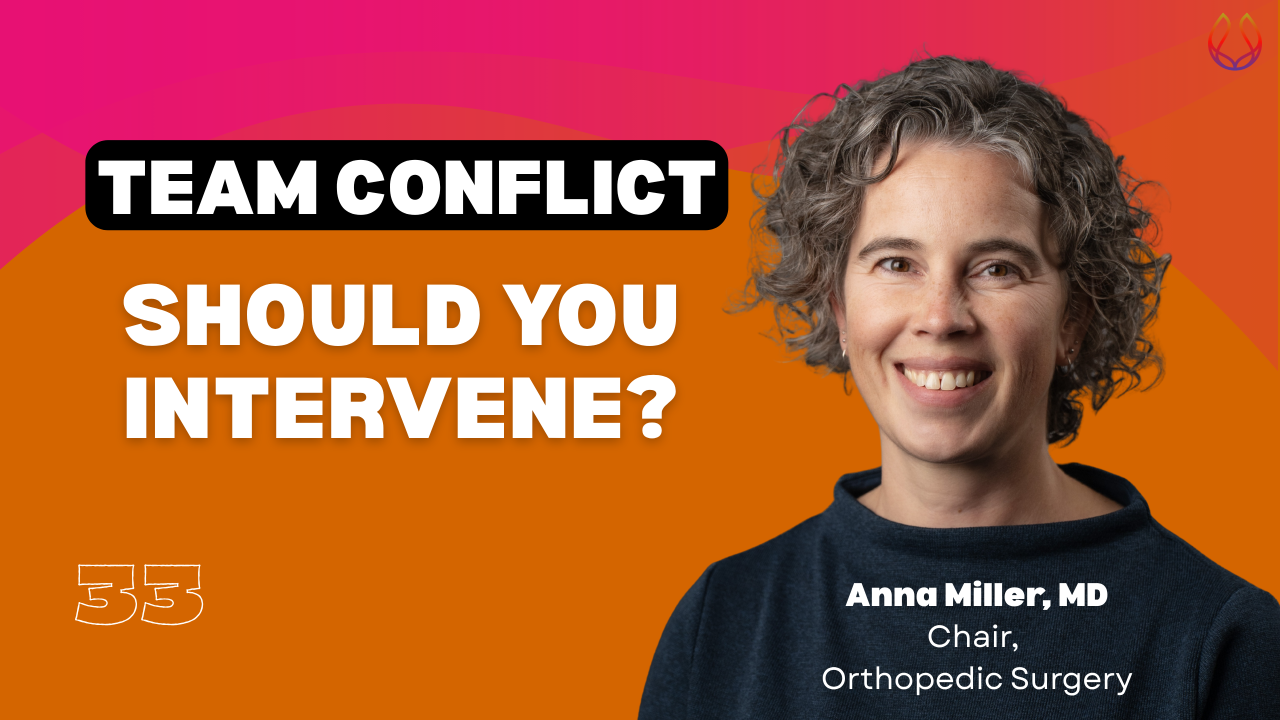
Episode 33 | Drama-Free Teams | Annie Campanile

Featured Guest: Anna Miller, MD
Anna N. Miller, MD, FAAOS, FACS, FAOA, is an orthopedic trauma surgeon, professor, and department chair with extensive experience in physician leadership and faculty development. She serves as Secretary of the Orthopaedic Trauma Association Board of Directors and on the American College of Surgeons Board of Governors, and was selected for the prestigious Executive Leadership in Academic Medicine (ELAM) Fellowship.
Two highly capable professionals on your team are stuck in conflict, and somehow you’ve become responsible for fixing it.
Stepping in may get things moving temporarily. But when you become the problem-solver every time, your team gets less practice having the difficult conversations they need to have without you.
In this episode, orthopedic surgeon and physician leader Dr. Anna Miller shares how she guides colleagues through conflict without taking responsibility away from them. We talk about what to do when someone would rather give in than have a difficult conversation, how to uncover what people actually want when they’re stuck at an impasse, and how your own decisiveness can unintentionally make it harder for other people to speak.
If you’re tired of getting pulled into other people’s conflict, this conversation will help you support your team without getting stuck in the middle.
***
6:00 How to Stop Being the Person Who Solves Every Team Conflict, So Your People Learn to Solve Their Own
7:00 The One Question That Lets Two Stuck Colleagues Both Get What They Actually Want
8:00 How to Stay Fact-Based Instead of Story-Based While You're Mediating a High-Stakes Conflict
9:00 How to Help a Conflict-Avoidant Colleague Finally Have the Hard Conversation, Without Shutting Them Down Further
12:00 Why Your Fastest Decision-Making Habit Might Be Silencing Your Best People, and How to Catch It
***
Resources
Get the Drama-Free Feedback Toolkit
Give your team a clear, practical structure for providing difficult feedback, resolving conflict, or repairing a relationship.
***
Other Episodes You’ll Love
Before You Quit Over One Difficult Colleague, Listen to This
What’s Really Driving Conflict on Your Team (And Why Many Leaders Miss It)
***
Next Time
Anna returns for a conversation about what to do when someone starts crying during a difficult conversation, so you can respond with compassion and still move the conversation forward.
If this episode would be helpful to a colleague, please share it with them. That’s one of the best ways you can support Drama-Free Teams.
Have Leadership Questions? Send them to me here.
Love this show? Share it with your colleagues.
***
Transcript
33. Your Team Is in Conflict. Should You Step In?
Annie Campanile: [00:00:00] When two highly capable professionals reach an impasse, stepping in to resolve the conflict for them might seem like good leadership, especially when the conflict is disrupting work or affecting other team members. But if you become the problem-solver every time, your team won't build the skills to work through conflict themselves, and you might burn out.
I don't want that for you, so keep listening because in this episode, physician leader and nature lover Dr. Anna Miller will share how she supports people during conflict without taking over so you can help your team move forward and get yourself out of the middle.
Annie Campanile: Last time, Miriam Dowling Schmitt shared what happened when conflict with a colleague became so frustrating that she left a job she [00:01:00] loved after she asked her leader for help and was offered a new position. Her leader meant well, but Miriam realizes now that the kind of help she really wanted was in figuring out how to stay in that job and work through the conflict with her colleague.
Dr. Anna Miller, my guest today, leads orthopedic surgery for an academic medical center. I think you'll really appreciate her approach to guiding colleagues through conflict without resolving it for them.
Annie Campanile: What inspired you to pursue such a high leadership role in addition to being a surgeon and everything else that you do?
Anna Miller: I have been really interested in leadership from an early age.
Over the years, I have tried to put myself in positions where I could get more leadership education, but also practice, which means being in leadership roles.
And I found over time that I really enjoy that, mostly [00:02:00] because it gives me an opportunity to do more for the people around me. And I think being the leader of a department, in my case, is one of the higher levels of that for medicine.
One of my mentors told me a long time ago that it's really important to have accomplished a lot of things that you wanna do with your career before you decide to take on a role like this, because once you get into a leadership role, at a department level at least, your job is really to help the people in your department, not yourself.
So you have to be ready to take that next step to being the leader for them and helping them with their careers, as opposed to continuing to be focused on your own career. One of my favorite quotes related to that is from George Russell, who was the chair at Mississippi for a long time, but now has moved to Pittsburgh, said, "When you're the chair, you're more like the moon.
When you're faculty, you're like the [00:03:00] sun." So you're, you know, the star of the show, you're glowing, you're building your career, and then when you're the chair, you're really reflecting the light back on your people and trying to help them. I really love that way of thinking about it.
Annie Campanile: Wow, that's so beautiful.
I love that idea. You know how a lot of people are promoted because they do our jobs really well, but then leadership requires such a different set of skills and, and even attitudes. How do you see other people struggling sometimes?
Anna Miller: I definitely think that's an issue, but I think the biggest thing is being able to kind of turn that ego part off and realize that you're right, it's not about building your own CV anymore. It's about helping everyone around you. So when an opportunity comes your way, saying, "I don't think I can do this right now, however, I have this wonderful person in my department that can do it."
I certainly have seen a number of leaders who [00:04:00] don't do that, who continue to try to promote themselves, who get frustrated, for example, if somebody in their own department doesn't include them on a research project, which is not really the way to go about it, in my opinion. There's a great book called What Got You Here Won't Get You There, and I think it's exactly what you're talking about, that your skills become very different.
For me, I am very interested in learning all the time. I'm always reading about leadership, about nature, about things outside of work, so I'm trying to broaden what I'm interested in all the time, and part of that for me is taking a new challenge and learning different skill sets, which this requires.
And I think there are people who just think about this as another thing to add onto their CV and not really as a different skill set and changing into that leadership role. So that's probably where I've seen the biggest [00:05:00] issues.
Annie Campanile: Yeah. You know, because this show is called Drama Free Teams, I'm always thinking about what sparks internal or interpersonal drama, and I think what you just described creates a- an internal drama, if you will, for a lot of people, where we think our role is going to be one thing and require or give us something.
But then, especially in leadership, we're being asked to do what you said, put others first, help them have the opportunities, learn how to communicate in difficult situations where before you could say, "Oh, I want my leader to take care of that," now people are saying that about you. So I'm curious, when you have seen highly educated, very competent professionals reach an impasse, let's say, maybe they both think they know what's right for the patient and they have very different opinions of what that is.
How do you help them through that? How do you help them move forward together?
Anna Miller: Many of us [00:06:00] tend to micromanage, where we think we know the best way to do something.
I think one of the biggest skills, and I have really tried to work on this, is letting other people figure out the right way to do something and empowering them to come to the solution themselves instead of just solving the problem for them, because then you are creating this environment where they think that you are the problem solver as opposed to them being the problem solvers.
So in that particular scenario, I think one of the biggest things is having those two people work it out amongst themselves, and not without guidance because they're already at an impasse, but to say, "What are the things around the scenario that maybe they can come to agreement on?" I think a great example is this classic story of two sisters who want an orange, and [00:07:00] they're both fighting over the orange, and the natural solution that comes to everybody's head is just slice the orange in half and give it to each kid.
But when you ask the kids why they want the orange, one wants the zest for baking, and the other one wants the juice, and if you know what their motives are, then they each get fully what they want, 'cause one can have the entire zest and the other can have the entire juice without compromise. I think understanding people's motivations and why they're fixed on whatever their position is, is really important.
Helping them understand that when they're at an impasse, and then asking them to come up with solutions is one strategy to try in that scenario.
Annie Campanile: How do you calm your own emotions or nervous system if they're at an impasse and maybe one or both are emotionally reactive? How do you navigate that aspect of [00:08:00] it so that you can get to what really motivates them and what they want?
Anna Miller: I think that's probably the hardest part because we all do get emotionally invested, and you may have your own opinion about which person is right or which way they should be going. We've talked about some of the techniques of just calming yourself and taking those deep breaths. Also, again, if you look at it on a facts base and not an emotion base and really trying to get to what the actual scenario is, where the actual motivations are, and then kind of helping everybody come out of that.
I'm certainly not an expert. I'd love to continue getting better at that myself, but really trying to make sure that it's focused on the facts and not the emotions or the made-up scenario that is potentially being created by the people involved.
Annie Campanile: Yeah. The made-up scenario, that's such an important one because our [00:09:00] survival brains are so good at making up stories that feel really true, that keep us anchored in I'm right, you're wrong.
Have you ever seen physicians, or let's say a physician with an APP, where somebody refuses to actually have the conversation? Maybe they have such a strong flee or avoidance response that they just will not engage. Have you ever had to deal with that or, or seen somebody else have to deal with that?
Anna Miller: I've definitely have seen that.
What comes to my head is more, as you said, avoidance of confrontation, where it's not so much like the aggressive side of it as I'd rather give up than have that conversation. That is definitely not how I tend to react to things, so I, I find it a little challenging to understand. So for me, that becomes more of a curiosity scenario where I just really wanna [00:10:00] understand why that person doesn't wanna have that conversation and what is motivating it.
Are they scared of it? Are they concerned that it's gonna change their relationship with the person that they're needing to have that conversation with? Do they just need help with it? It's really more understanding what their concern is, because I do think people sometimes tend to, for example, agree to something they don't really wanna do because they'd rather agree than have that confrontational, for them in their mind, confrontational experience.
So I think just really talking through why they're having that response is helpful and privately without the other person there, to understand why and how I can help. Because I'd rather them come to some agreement that's helpful for both of them, as opposed to this one side always getting kinda steamrolled by the other side.
I've definitely seen that, and I [00:11:00] think for me that's one of the more confusing ones because it's so opposite of how I approach things. So really talking to them more is my first kind of go-to for that.
Annie Campanile: This is why I'm so glad you are a leader. Because many people who don't avoid conflict and who can be confident when confronted become irritated by a person who's avoidant, especially if their own fight response is triggered in any way, then somebody who is more avoidant or flee, that is very difficult for them to sit with or they get aggravated.
We all get irritated, but when a leader is irritated at someone who is not asserting themselves When they speak to them from that irritation, that other person tends to shut down even more.
But by doing what you're saying, coming alongside of them privately, getting curious what's going on for you, you're helping to build that psychological safety that [00:12:00] might really help them make a breakthrough.
Anna Miller: Hopefully. I - can't say I always keep my irritation away too, but it's something I try to avoid or at least try to keep it not obvious to the person I'm talking to, hopefully.
Annie Campanile: Something you said around not being avoidant makes me think about surgeons in general. We, in healthcare, expect surgeons to be the leader in the OR, to make quick decisions, to have the right answer a lot of times. How do you think that influences your communication as a leader, and is there anything you've had to overcome in order to be the kind of leader that you want to be?
Anna Miller: That is actually a really important question because in the OR, I think that is actually a habit to really be mindful of and to watch out for because I do think we tend to be assertive and decision-makers and move forward.
And to your point about the avoidant person, it [00:13:00] might end up just kind of steamrolling other people. It's definitely my go-to behavior would be to be a fast decision-maker and move forward, and- ... I definitely have to curb that along with the micromanaging 'cause they go together.
And I feel like those are things that I have to control myself and try to stop doing when I'm not in the OR and even sometimes in the OR to allow a learner to make a decision, give them a second to think about it, because it certainly can keep other people around you quiet if they think you're always gonna just make the quick decision and move forward.
You do need to do that sometimes, but to allow people the space to be able to speak up, and especially the more maybe introverted person who would like some time to process before moving forward, you're gonna really squash that person if you don't think about it a little bit.
[00:14:00]
Annie Campanile: Anna, thank you so much for joining me and for sharing so openly about your approach to leadership under pressure and what you're still learning as a leader.
For you listening, I'd like to revisit three actions that will be especially helpful the next time you're faced with professionals who are stuck in conflict and you need them to move forward. First, resist the urge to solve the conflict for them. Provide support, but leave the responsibility for resolving the conflict with the people involved.
If they need help having the conversation, my twenty dollar Drama-Free Feedback Toolkit will give them a clear, practical structure that they can follow. Click the link in today's show notes for the twenty dollar Drama-Free Feedback Toolkit. The second action I really appreciated from Anna today is get curious when someone avoids a difficult conversation.
Instead of being frustrated, try to understand what they're trying to avoid. [00:15:00] This can help you provide the support they need in order for them to hold a difficult conversation well.
And three, notice when your own decisiveness might be making it harder for someone else to speak openly.
If you think this episode would be helpful to a colleague, please share it with them. That's one of the best ways you can support the show.
Next time, Anna and I will explore what to do when someone starts crying during a difficult conversation. We'll make it really clear so you can respond with compassion and still move the conversation forward.
Dr Annie Campanile: Until then, I'm Dr. Annie Campanile, reminding you that conflict is natural and drama is optional. See you next time!
©℗ 2026 Dr. Annie Campanile. All rights reserved.