Why Your Leadership Gets Misunderstood (and How to Change That)
Jul 15, 2026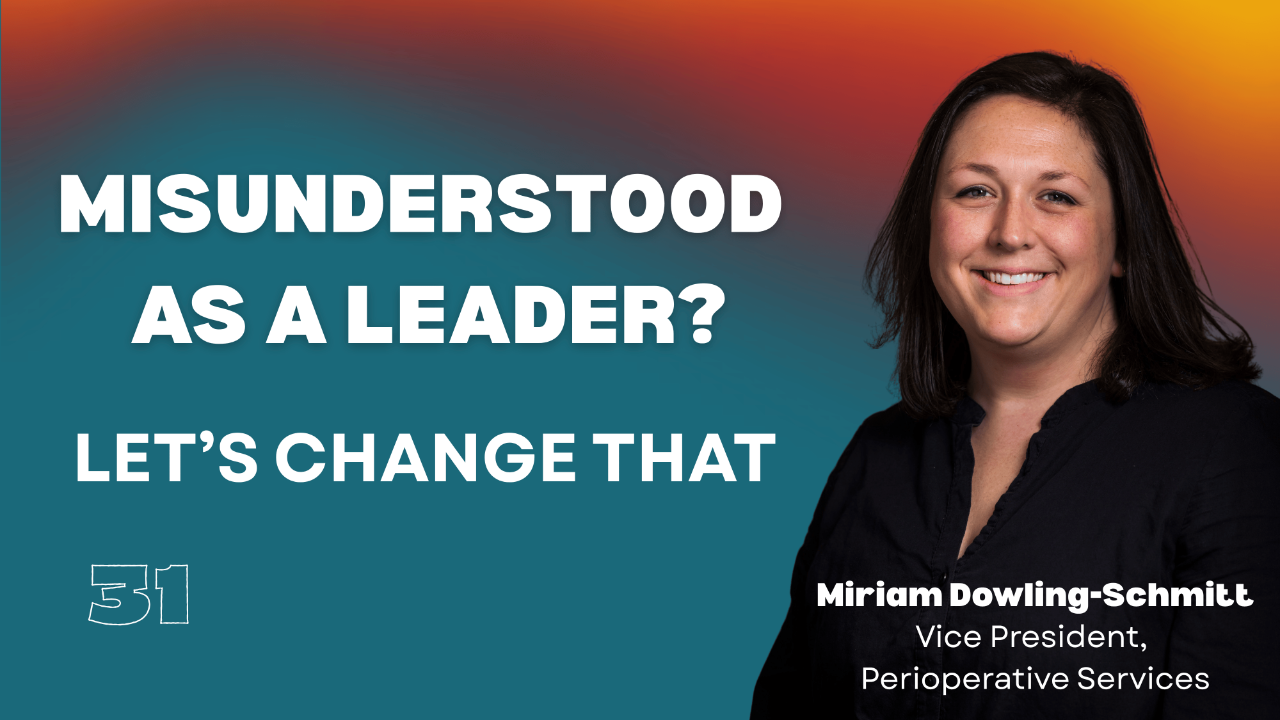
Episode 31 | Drama-Free Teams | Annie Campanile

Featured Guest: Miriam Dowling-Scmitt, DNP
Miriam Dowling-Schmitt, DNP, RN, CENP, FACHE, is the Vice President of Perioperative Services at a large academic medical center in New England, a role she never imagined when she started her nursing career in an adult intensive care unit and just kept saying yes as opportunities arose. A life-long learner, she hones her communication skills by talking to dogs and horses (people too) and she is pursuing her PhD after completing her doctor of nursing practice degree two years ago. She lives in an 1820s farmhouse with her husband, Will and their two young children, Abigail and Theodore.
0:00 — The Observe-Before-You-React Habit That Closes the Gap Between Your Intentions and Your Impact
03:30 — The Deep Breath and Body-Language Read That Keeps You Credible When the Room Is in Crisis
08:25 — Naming Your Intent Out Loud So Your Casual Comments Stop Landing as Orders
09:55 — The Exact Phrase That Gets Your Team to Push Back Instead of Just Agreeing With You
10:45 — The Two-Part Apology That Repairs Trust Without Losing Your Directness
11:25 — A 90-Second Practice to Strengthen Leadership Presence before Your Next Meeting
...
Episode Links:
Meet Miriam Dowling-Schmitt: LinkedIn
Get the free Drama-Free Leadership Starter Kit
...
Why Your Leadership Gets Misunderstood (and How to Change That)
You know that moment when you walk out of a difficult conversation feeling satisfied that it went well, and then later you find out that it actually didn’t?
That gap between how you experienced the conversation and how the other person experienced it can undermine even your best intentions.
Miriam Dowling-Schmitt knows that gap well.
Early in her nursing career, she loved high-intensity clinical moments. As a charge nurse, when something urgent happened, she felt energized, needed, and ready to act.
Then she received anonymous survey feedback that she “wasn’t good in a crisis.”
She was, in her own words, unbelievably offended.
Crisis was her favorite! She wanted nothing but to be in one. She enjoyed that rush of intensity.
But over time, Miriam came to understand that her confident enthusiasm during a crisis sparked anxiety in colleagues who were already stressed or scared.
That is one of the hardest leadership lessons to absorb:
Your good intentions do not
automatically create the impact
you mean to have.
Especially under pressure and when you have a leadership title.
People receive not only your words, but also your urgency, your energy, your authority, all through the lens of their own nervous system's response to the stressful situation.
That's why your leadership can be misunderstood.
The Observe-Before-You-React Habit That Closes the Gap Between Your Intentions and Your Impact
You may intend to be helpful, decisive, efficient, or confident. But your team may experience you as rushed, intimidating, micromanaging, or unapproachable.
Under pressure, your internal state shapes how you show up. Your team’s internal state shapes how they receive you. Those two things can miss each other completely, even when your intentions are good.
That is why the most important leadership communication skill during a crisis is not choosing the perfect words.
It is observing before you respond.
When you pause long enough to notice what is happening inside you and around you, you give yourself a chance to respond to all of the people and dynamics in the room, not just the urgency you are feeling.
Miriam uses this simple, 4-step practice that increases the chances her impact will be positive during a crisis:
- Pause
- Take a deep breath
- Read the body language of the people around you
- Respond to the needs in the room while also empowering others to act
Reading body language and responding appropriately can make the difference toward you being viewed as the leader people can rely on during a crisis.
Name Your Intent Out Loud So Your Casual Comments Stop Landing as Orders
It took Miriam almost two years as vice president to understand the actual weight of her title.
The same offhand comment, joke, or casual idea that was normal as a director or bedside nurse was interpreted very differently once she was the vice president.
She described loving to throw ideas out in a meeting. Some of them could be terrible ideas and she enjoys hashing them out with others.
But her team might hear the idea and say, “Okay, Miriam, yeah, I’ll do that.”
That is not what she wants.
To overcome the unintended intimidation of her title, Miriam practices stating her intention up front.
It's simple, even if it isn't always easy.
State your intent up front:
- If you are brainstorming, say that. Express appreciation when others offer feedback and ideas, and don't critique them until after brainstorming is complete.
- If you are communicating a directive, say that. “Often, I want you to push back, but I need you to know that what I’m going to share now is a directive.”
- If you are testing an idea and want pushback, say that.
Your people should not have to guess whether your comment is casual, exploratory, or final, and the higher your authority, the more useful it becomes to name your intent before your team's fear brains interpret it for you.
This is one of the most practical communication skills for leaders: stop making people decode your intent while also trying to manage their responses to your authority.
The Two-Part Apology That Repairs Trust Without Losing Your Directness
Even when you are trying to communicate clearly, your words will miss the mark sometimes. It happens to everyone.
Miriam still has moments when she does't nail it. She has received feedback that she came across too harsh, even when that was not what she intended.
Her response has become a practice of its own: apologize for the impact, then clarify what she meant.
The repair can be as simple as:
“I’m really sorry that it came across that way. What I meant was this.”
Two-part repair:
- First, acknowledge the impact and apologize.
- Then clarify your intention.
If you only apologize, the other person may feel understood, but the original message you intended might not be received.
If you skip the apology and only clarify your intention, the other person may feel slighted or corrected, and then stop listening.
Repair requires empathy and humility to acknowledge your unintended impact, plus clarity to say what you actually meant.
That is how leaders maintain directness without becoming defensive.
A 90-Second Practice to Strengthen Leadership Presence before Your Next Meeting
The practice Miriam is working with now is pausing for 90 seconds to observe the energy in a room before she acts.
You can build the same habit into any high-stakes moment, starting with the next time you log into a call or walk into a meeting. It only takes 90 seconds.
90-Second Practice
- Before you say anything, pause for one full breath.
- Just observe.
- Notice people’s body language.
- Notice the energy in the space.
- Notice who is talking.
- Notice who has gone unusually quiet.
You may discover that people need something very different from what you expected. That awareness can help you respond differently.
This habit can help you build the kind of credibility that is resilient, even when you make mistakes (which you will, since you're human, and that's 100% perfect).
...
Resources:
My free Drama-Free Leadership Starter Kit will help you create the conditions where you and your colleagues can stop defending and start communicating.
...
Next time, Miriam and I explore what to do when you’re tempted to walk away from a job you love because of a conflict that seems impossible to resolve.
...
TRANSCRIPT
Dr Annie: [00:00:00] You know that moment when you walk out of a difficult conversation feeling satisfied that it went well, and then you find out that it actually didn't?
That gap between how you view yourself as a leader and how others view you can undermine even your best intentions. My guest today, Miriam Dowling-Schmitt, is a nursing executive and lifelong student of animal behavior who's going to show you how to close that gap for good, so you'll know exactly what to do when your impact doesn't match your intentions.
Speaker 4: Welcome to Drama Free Teams, the show for leaders who care deeply and want their teams to thrive without the drama. I'm your host, Dr. Annie Campanille. Let's make your team drama-free.
Dr Annie: Welcome to season two of Drama Free Teams. This season, I'm bringing more guests to the show, leaders who are working to improve their own communication skills and reduce interpersonal drama on their teams every single day.
My guest, Miriam, began her nursing career [00:01:00] in the ICU and grew to become a vice president while also pursuing her PhD and constantly refining her communication under pressure
Something that I loved about your bio was that you grew up in the woods- Mm-hmm
in northern New Hampshire, talking to dogs. That is so fun.
Miriam: Always.
Dr Annie: So I'm super curious, what have you learned from dogs that helps you in communicating with people or building trust with people?
Miriam: I feel like I have learned so much in talking to dogs, to horses, to deer.
I chitchat with all of the deer on my bike ride to work every day. And actually, this is something that you mentioned once upon a time when I was talking about why I like working with horses and, and other animals so much. And you said, "Well, there are certain base instincts that come with being a person that don't really change as you get older."
Mm-hmm. I think in that, in that moment I was talking about how I learned so much about my colleagues after becoming a mother, and how I didn't want to, like, infantilize my colleagues. Yeah. [00:02:00] But I just learned so much about how to treat people. And you said, "Well, there are certain things about you as a person when you're growing up that don't really change that much."
And what's so interesting is there are so many things about horses and dogs and cats and every other critter-
Dr Annie: Yeah ...
Miriam: that we can connect with as people. Growing up, I always wanted a dog. We didn't get a dog till I was four. So I think I understood the weight of the gift of that animal.
Dr Annie: Yeah.
Miriam: And started reading her body language and, just that incredible connection that you can have, especially with a dog. She was a chocolate lab, Bailey- Oh ... when I was growing up. Labs are so forgiving. They're so kind. They're so energetic. There is no one in the world who will greet you like a dog when you get home.
I just learned so much about how I wanted to be treated in the world and how I want to treat other people from the love of a dog, and it's never left me. I love them so much.
Dr Annie: It's so [00:03:00] beautiful. I love that you have this perspective with animals because it's true. They have that- survival response just like we all do.
Miriam: Yep.
Dr Annie: And dogs, are so present and so sweet and so responsive, but also very observant.
Miriam: Mm-hmm.
Dr Annie: I remember noticing that, and I certainly became a very observant child in a very chaotic home.
Miriam: Mm-hmm.
Dr Annie: So whether you're outdoors observing nature or you're indoors observing other kinds of wildness- Mm-hmm ... with people, being able to observe and then respond-
Miriam: Yep ...
Dr Annie: rather than react-
Miriam: Yep ...
Dr Annie: is so helpful.
So as a vice president of Periop and starting in the ICU as a nurse-
Miriam: Mm-hmm ...
Dr Annie: you've been in nursing for so long.
Miriam: Mm-hmm.
Dr Annie: What's one thing that you do to help yourself stay, stay grounded or get grounded-
Miriam: Mm ...
Dr Annie: when you get that jolt of fear or anger or stress in those moments that get really intense?
Miriam: Honestly, I still think it's [00:04:00] really hard for me. I've been a nurse for almost 20 years now, and I love those high-intensity environments, and I think that I like them so much because I feel this energetic response to something is happening and someone needs me, and I am ready to act.
And I think that rush of endorphins and, and all the other neuro, transmitters that happen when you feel that, that makes me so excited about what I get to do. And it's really interesting that even though I'm not in a clinical setting anymore, I still feel that. Like when I hear, our air handling system is down in the OR, I'm like, "Oh, they need me to help plan."
"This is gonna be great." And I still sort of get that rush as if I was, the one doing chest compressions and saving someone's life. So I still really struggle with how to calm myself in that moment, and I remember as a charge nurse in the ICU getting the feedback via an anonymous survey that I wasn't good in a crisis.
Dr Annie: Wow.
Miriam: And I was [00:05:00] so unbelievably offended 'cause I was like, "Crisis is my favorite." Mm-hmm. "I, I want nothing but to be in a crisis. I really enjoy that." And I think it's because I grew up in a very calm setting. There was never a crisis, and so I was just like- Amazing ... "This is really interesting." It was novel for you.
"I like this feeling." It was novel. Um, and I, I realized after getting that feedback that I was so excited in that moment, and other people didn't know what to do with that energy 'cause I would come rushing into a room where a patient was coding or hemorrhaging and just be everywhere and doing everything and just, like, feeling the rush and loving it.
So it takes me- a little while to calm down and go, "Not everyone is excited about this. A lot of people are scared."
Dr Annie: Mm-hmm. "
Miriam: They don't like this. These feelings bring back feelings for them that are not positive. And I need to center myself for a moment, take a deep breath, and read the body language of the people around me, and respond [00:06:00] to what they need, 'cause I'm the leader in this situation."
And that has taken me a long time, and I still don't always nail it. Yeah. But I think especially in my time doing natural horsemanship training, I sort of always bring it back to horses and other animals. Horses are very naturally traumatized. They're prey animals. The way we train horses can be very brutal, and oftentimes you don't know the history of a horse.
Sort of like if you walk into a work situation, you don't know the history of the person that you're working with. You have to read that animal very quickly in order to stay safe yourself, because a horse can hurt you very quickly with just a kick. So you have to be able to read their body language and respond appropriately.
I think as I've gotten older and I've gotten further in my leadership career, I've gotten a little bit better at getting into a situation and reading someone's body language and going, "That person is wildly uncomfortable."
Hmm. "I either have to change the situation that's happening, or I have to [00:07:00] include them differently somehow." That has been really helpful in taking the focus off of me and how I'm feeling, and realizing that my part in that intense situation is actually to help the other people.
Dr Annie: Yeah. What I'm hearing from you is- ... all of your practice in observing nature, observing dogs growing up- Mm-hmm ... observing your children, you're applying that as you have progressed in leadership, and this is something all leaders really would benefit from.
Miriam: Mm-hmm.
Dr Annie: Because ... Yes, we get promoted because we do our jobs well and we have the capacity to have more influence, to have more responsibility. And so often high achievers unconsciously take that as, "I have to be the rescuer," or, "I can be. I want to." And yet, like you said, you walk into a room, maybe our heightened energy, other people's nervous system takes as dangerous- Mm-hmm
or, "Oh my gosh, I have to be doing more faster."
Mm-hmm.
So that skill of [00:08:00] pausing, take a breath, looking outside of ourselves to notice what other people are feeling, is such a skill. And it is a skill I think we all can refine forever.
Christopher: Mm-hmm.
Miriam: I'm still working on apologizing and being more realistic about what did my actions mean in that situation. We were talking earlier this week about how I have not realized the, the weight of being a vice president.
Dr Annie: Yes.
Miriam: It's been two years now, and the things that I was able to say, even as a director, a bedside nurse, anything like that, it is so different if I say it now.
Dr Annie: Like a, like an offhanded comment or a
Miriam: joke or- Offhanded comment, joke, all of those things. Mm. The way people will immediately react to me, 'cause I try to be very authentic. I try to be who I am, and who I am is now different because of this title that I have, so that has been really interesting [00:09:00] for me to try to work through that and realize that I have this seat of authority now, and people will respond to that.
Dr Annie: Mm. The boundaries
Miriam: have
Dr Annie: to change. And I have
Miriam: to... the boundaries have to change. I have to be more respectful. I have to realize that people are more likely to do what I ask of them. I love to just throw ideas out there, and they could be terrible ideas, and they'll say, "Okay, Miriam, yeah, I'll do that."
And I'm like, "No, no, no. Wait a second. We're, we're hashing through this. What do you have to give me in return?" And they're like, "Whatever you want to do." And I'm like, "Oh, no." "That's not, that's not what I wanted. I wanted to hear what you thought. I wanted you to push back on what I was thinking." And that, that power dynamic is so different now.
Yeah. And I never had that, especially I feel like as a, as a woman .. i never had that white male authority that many people are, are gifted with, and it wasn't until I started getting into leadership more and more and more that I fully understood, oh, oh- Mm-hmm ... the power dynamics are different here.
Dr Annie: And all of the assumptions people make-
Miriam: Mm-hmm ...
Dr Annie: about a [00:10:00] person with a particular title.
Miriam: Yep.
Dr Annie: And to keep themselves safe.
They interpret any comment as a directive, as you're saying.
Miriam: Exactly.
Dr Annie: So to build your toolbox of creating psychological safety with folks to be able to push back when you say, "I actually really want to know what you think"-
Miriam: Mm-hmm
Dr Annie: so they don't just say, "Well, I think it's really good," right?
Miriam: Yeah.
Dr Annie: That takes time.
Miriam: Yep. And what I'm still struggling with is there are times when I don't want them to push back, and it is a directive. And how do I differentiate between those two things? Mm-hmm. So that is something that I'm still very much learning.
Dr Annie: Oh my gosh, and it can be so simple, really-
Miriam: Mm-hmm ...
Dr Annie: to say, often I really want you to push back. Right now I need you to know what I'm gonna share, it actually is a directive.
Miriam: Yep, and I still haven't nailed that yet, even though like the way you say it is so simple and beautiful and perfect. Like in the moment, I've gotten feedback like, "Well, you came across way too hard."
Mm. And I'm just like, "Oh, didn't nail it." Yeah. "All right. I'm gonna try again differently." [00:11:00] And then- That's the key ... working on apologizing and saying, "I'm really sorry that it came across that way. What I meant was this."
Dr Annie: Yeah.
Miriam: You know, and I hope that I can be more proactive and say it in the moment, my intent is this, which is a tool you introduced to me earlier this week.
Yeah. And I don't mean to be authoritarian, but this is really important. We need to get this done.
Dr Annie: Yeah.
Miriam: That sort of thing.
Dr Annie: Yeah.
Miriam: Yeah.
Dr Annie: Every day is a new day to practice, and- Yep ... we all get so many opportunities.
Miriam: Yep.
Dr. Annie: Miriam, thank you so much for being here today. I just love how much you've taught us about observing before reacting. And I have to say, I will never think about dogs and horses quite the same way again. And as always, for you listening, I want to leave you with an activity you can do in 90 seconds or less.
Now, before we move into today's 90-second activity, I want to briefly pull together what Miriam taught us because there were three really important insights woven throughout this conversation. First, leadership does not require perfection. [00:12:00] Miriam reminded us that one of the most powerful things a leader can do is notice when their impact wasn't what they intended, apologize when appropriate and then try again. Second, our, impact is not determined by good intentions alone. It's also shaped by the energy we bring into a room, our body language, and the authority of our job title. If you notice that your impact isn't as you intended during a high-pressure moment and someone is really uncomfortable, try Miriam's approach. Either change the situation that is happening or include them differently. And third, effective leaders become skilled observers of what's happening around them. They notice who feels comfortable, who's anxious, who's gone quiet, and they adjust their approach accordingly.
If you're wondering how to adjust your approach, register for my free Drama Free Leadership Starter Kit. It's a complete resource that walks you through the four fundamentals of drama-free communication [00:13:00] and includes a full workshop and thirty-four-page workbook full of practical tips and activities. Click the link in the show notes for the Drama Free Leadership Starter Kit.
Now, here's the activity you can do in ninety seconds or less to shape the impact you'll have in your very next meeting. The next time you log on or walk into a meeting, before you say anything, pause for one full breath and simply observe.
Notice people's body language. Notice the energy in the space. Notice who's talking and who's unusually quiet. And then ask yourself, "What might these people need from me right now?" And trust your instincts. You may discover that people need something very different from what you expected, and that awareness can help you build trust by responding differently.
Next time, Miriam and I will explore what to do when you're tempted to walk away from a job you love because of a conflict that seems [00:14:00] impossible to resolve. Until then, I'm Dr. Annie Campanile, reminding you that conflict is natural and drama is optional. See you next time!